
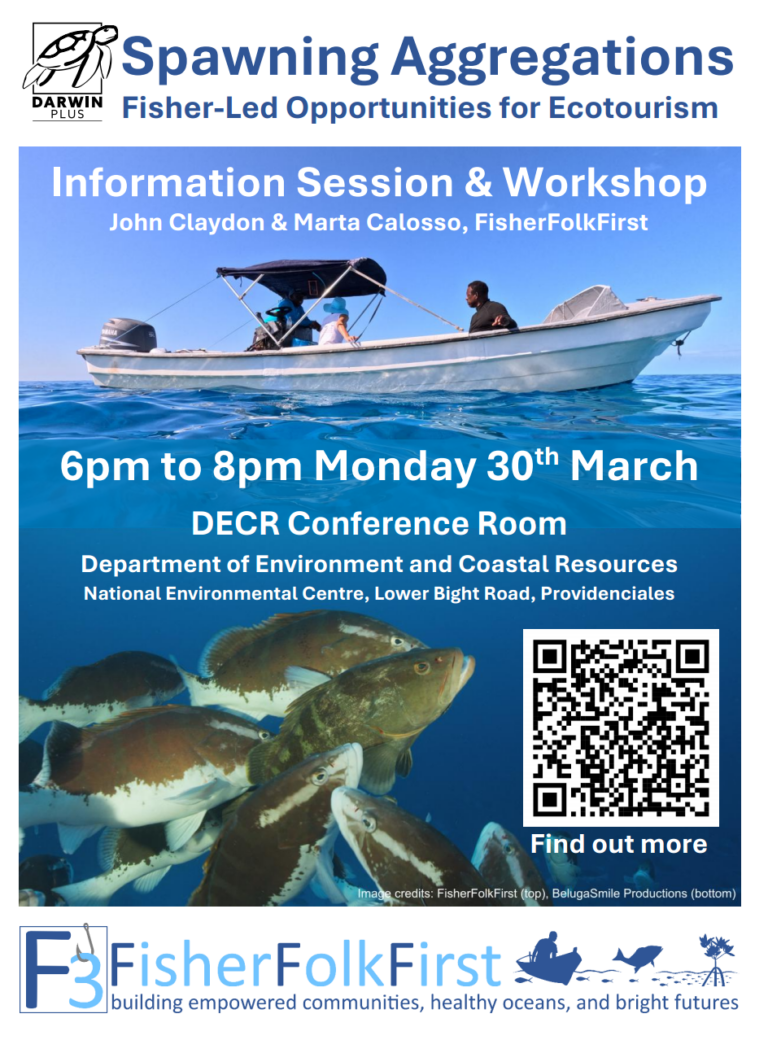
Information Session and Workshop – Providenciales
Monday 30th March 2026
6pm to 8pm
Location: The information session and workshop will be held at the Department of Environment and Coastal Resources Conference Room on the Lower Bight Road, Providenciales.
Light refreshments will be provided
Virtual attendance
We will try to stream the meeting live on Zoom at this link: https://zoom.us/j/95599292304?pwd=Xr1pmzTof8Sj8TGgD5RYgkfwVcc5lx.1
Meeting ID: 955 9929 2304 Passcode: 687083
Objectives of the Information Session and Workshop
Summary
The first part of the meeting will be to present information about spawning aggregations of reef fishes, their ecological importance, and their potential as resources for ecotourism.
The second part of the meeting will be a discussion based around these three questions:
- How can we ensure that fishers benefit directly from spawning aggregation ecotourism?
- What guidelines should be adopted to ensure that spawning aggregation ecotourism develops in a responsible way?
- How can we ensure that fishers are engaged in any research or monitoring of spawning aggregations of reef fishes?
Background
Spawning aggregations of fishes are often spectacular phenomena where thousands of fish gather together to reproduce. Some species, like parrotfish and surgeonfish, do this almost every day. Others species, like groupers, focus spawning around a specific phase of the moon for only one or two months a year.
In the Turks and Caicos Islands, all spawning aggregations are protected (except for those of mutton snapper). A closed season for Nassau grouper during its reproductive period is also designed to prevent their spawning aggregations from being fished. In addition, fishing is not allowed in the country’s network of marine protected areas which includes numerous spawning aggregations sites. While these regulations may be good for the species concerned, they impact small-scale fishers’ livelihoods.
Our project aimed to assess whether spawning aggregations could become a non-extractive resource for fishers – i.e., instead of making money from fishing spawning aggregations, can small-scale fishers supplement their livelihoods by developing tourism around these ecological phenomena?
Typically, when measures are implemented that restrict fishing but promote tourism, fishers do not end up benefitting. Instead, other stakeholders (e.g., pre-existing tour operators) tend to profit at the expense of fishers. Therefore, it is crucial to ensure that any development of spawning aggregations as an ecotourism product happens in an equitable and just way directly benefitting fishers.
In addition, spawning aggregations are often focal sites of scientific studies and monitoring, and so we also wanted to make sure that fishers were involved in this research too.
Fishers’ ecological knowledge has value and should not be exploited unfairly by other stakeholders.